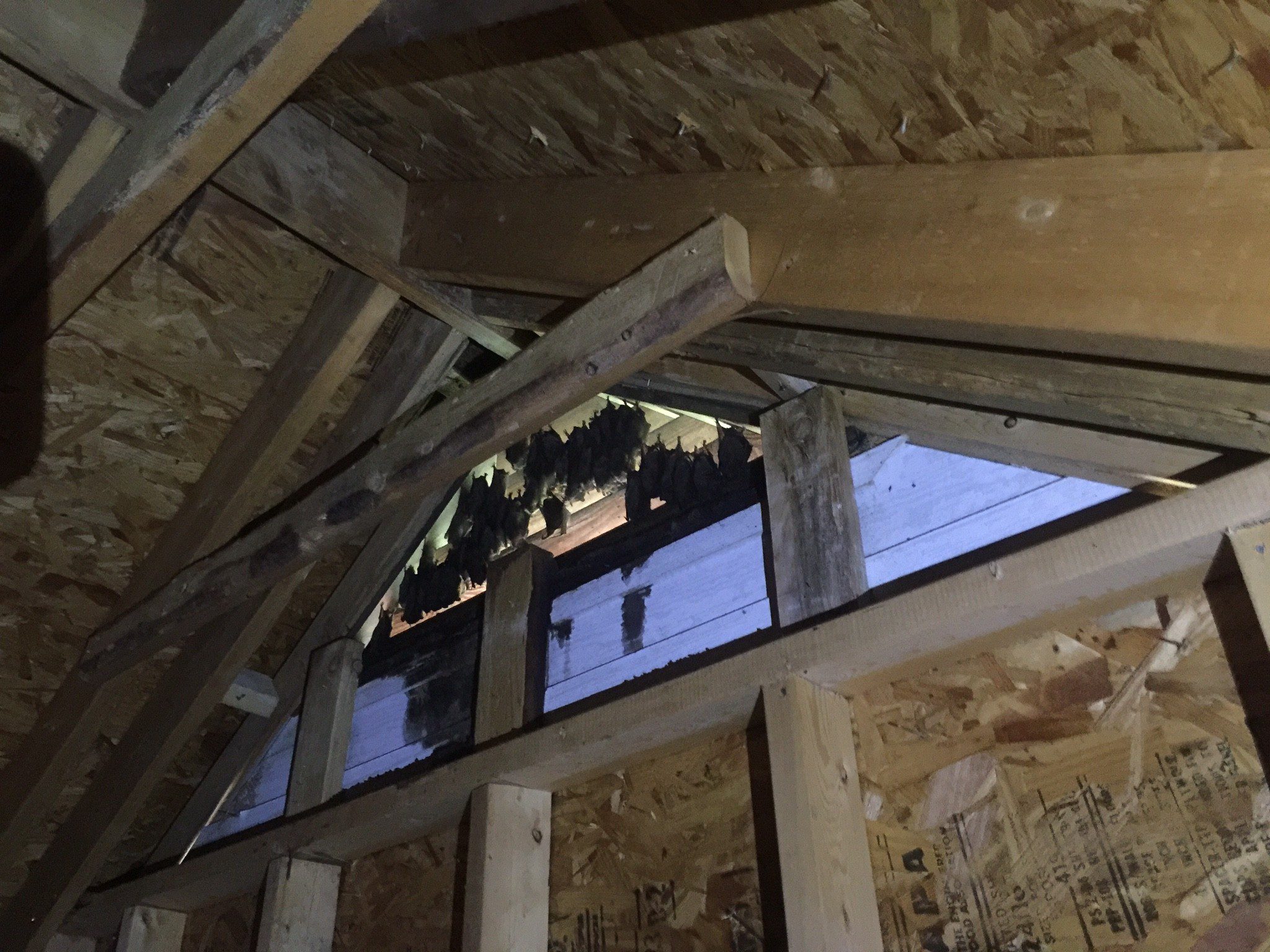
Georgia bat laws you should know:
Bat exclusion is prohibited during maternity season (June 1 – July 31) without special permits.
It is illegal to kill bats or use lethal traps.
Exclusion devices must be installed by licensed professionals.
We comply with all regulations and only perform exclusion work at legal times, using humane methods approved by the Georgia DNR.

Unlike other wildlife, bats are protected in Georgia during certain seasons. We comply with all Georgia DNR regulations, using humane exclusion methods that do not harm bats.
Our technicians:
Perform a thorough inspection of your roofline, soffits, fascia, vents, and chimneys to identify all bat entry points (bats can squeeze through gaps as small as 3/8 inch).
Determine the bat species and colony size (typically big brown bats or little brown bats in Atlanta attics).
Install one‑way exclusion valves (bat cones or tubes) at active entry points. Bats can exit to forage at night but cannot re-enter.
Never use poisons or lethal traps – bats are protected, and killing them is illegal in Georgia during maternity season (June 1 – July 31).
Schedule exclusion work outside of maternity season when possible, or we use approved exclusion methods that allow pups to leave naturally.
We follow all state and federal laws, including the Georgia DNR guidelines for bat management.

After all bats have been excluded, we permanently seal every potential entry point on your home’s exterior using professional-grade, bat-proof materials:
High‑quality silicone caulk and sealant for small cracks and gaps.
Steel wool or copper mesh stuffed into larger openings before sealing.
Custom‑fit vent screens (fine mesh) for attic, gable, and soffit vents – bats cannot push through.
Chimney caps to prevent bats from entering the flue.
Roofline flashing repairs where bats exploit gaps between roofing materials.
Soffit and fascia sealing to close any gaps where bats roost.
Result: Your home becomes physically bat-proof. Bats cannot re-enter through any gap.

Bats leave behind guano, urine, and parasites – all serious health hazards. Bat guano can contain Histoplasma capsulatum, a fungus that causes histoplasmosis, a severe lung disease. We restore your attic through:
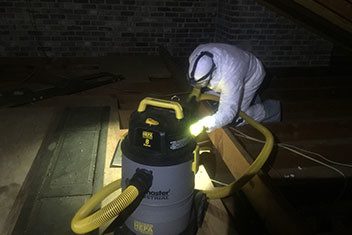
HEPA vacuum removal of all guano, contaminated insulation, and nesting debris.
Hospital‑grade disinfectant fogging of the entire attic space to kill fungal spores and bacteria.
Parasite control for bat bugs, mites, and fleas that bats carry.
New insulation installation (fiberglass or spray foam) to restore energy efficiency.
Odor neutralization to eliminate the ammonia smell from bat urine.
Structural damage repair for any wood or drywall stained by guano.

Bats cause specific types of damage that require professional repair:
Guano staining on wood, drywall, and insulation – staining can be deep and may require replacement of affected materials.
Urine damage to ceiling drywall – bat urine can seep through drywall into living spaces.
HVAC contamination – bat guano in air ducts spreads histoplasmosis spores throughout your home.
Insulation destruction – guano saturates and compresses insulation, destroying its R-value.
Soffit and fascia repair where bats entered and roosted.
Bats flying around your home at dusk – Seeing bats emerge from your roofline, soffits, or vents at sunset is the most obvious sign of a colony.
Dark staining around vents, soffits, or chimneys – Bats leave oily residue and guano staining near entry points.
High‑pitched chirping or squeaking – Listen at dusk or dawn from your attic. Bats are vocal, especially when pups are present.
Strong ammonia odor – Bat urine and guano produce a distinct, pungent smell that worsens over time.
Guano (droppings) in attic or on exterior walls – Bat guano looks like mouse droppings but crumbles into shiny, powdery dust when crushed. It often accumulates below entry points.
Greasy rub marks – Bats squeeze through tight gaps, leaving dark, greasy stains around entry holes.
White powdery residue – From dried guano or fungal growth on insulation and wood.
Unusual pet behavior – Dogs or cats fixating on attic access panels or ceiling areas.
If you notice any of these signs, do not wait. Bat colonies grow quickly, and guano accumulation creates immediate health risks.
Our specialist examines attic, roofline, vents, chimneys, and soffits to locate bat colonies, entry gaps as small as ½ inch, and guano accumulation.
One‑way bat valves installed at all active entry points. Bats exit at dusk to forage but cannot re‑enter — no killing, no trapped bats inside walls.
Heavy‑gauge vent screens, chimney caps, roofline flashing, and copper mesh seal every gap larger than ½ inch against re‑entry.
HEPA vacuum extraction of toxic droppings and nesting debris, hospital‑grade fogging to kill histoplasmosis spores, plus new insulation installation.
Do not attempt to clean bat guano yourself. Histoplasmosis spores become airborne when dry guano is disturbed,
causing severe respiratory illness. Always leave cleanup to trained professionals.
Hearing high‑pitched chirping in your attic at dusk? Noticing dark greasy stains around vents or chimney? That is bat activity — not birds or squirrels. Bats roost in colonies of 50 to 200 individuals, squeezing through gaps as small as ½ inch. We dispatch bat removal specialists daily across Cumming, Suwanee, Alpharetta, Johns Creek, Milton, Buford, Duluth, Roswell, Woodstock, Canton, Gainesville, and surrounding communities.
When you look for “bat proofing near me” or “bat guano removal near me,” you need a team that follows Georgia DNR laws. The ridge vents in Roswell homes, the gable vents in Cumming, or the chimney caps in Alpharetta — bats exploit these same features across North Atlanta. We know exactly where to install one‑way bat valves and how to seal permanently.
Our average response for a free bat inspection is under 90 minutes. No franchises, no call centers. Just local, licensed wildlife professionals who will exclude every bat humanely, comply with all maternity season regulations, and decontaminate your attic with hospital‑grade cleaning.
Yes. We provide a 100% free, no-obligation inspection that includes a written report with photos of entry points, bat activity, and guano accumulation. You only pay when you approve work.
We inspect the attic and roofline to identify bat entry points and active areas. Then, we use appropriate exclusion methods to allow bats to leave safely while preventing them from returning.
Bat removal typically refers to trapping or killing bats, which is often illegal in Georgia. Bat exclusion is the legal, humane method of installing one‑way valves that allow bats to exit but not re‑enter. Exclusion is the only permanent solution. We perform exclusion only.
We never kill bats. Bats are protected in Georgia, and killing them is illegal during maternity season. We use humane one‑way exclusion valves and proofing methods that comply with all state and federal laws.
In most cases, no. Georgia law prohibits bat exclusion during June 1 – July 31 because baby bats cannot fly and would be trapped inside to die. We can perform inspections and plan exclusion for August. In rare emergency cases (e.g., bats entering living spaces), we may obtain special permits.
Most bat exclusion jobs are completed within 3–7 days of the inspection, not including waiting for the maternity season to end. The one‑way valves remain in place for 5–7 days to ensure all bats have exited. After removal, sealing and attic restoration take another 1–3 days.
Bats can return if entry points remain open after removal. We identify vulnerable areas around the roofline, vents, and other openings and recommend exclusion measures to help prevent re-entry.
Ready to get rid of the nuisance wildlife that’s been damaging your home and keeping you up at night? You’ve come to the right place.
© 2026 A & A Wildlife & Home Solutions